
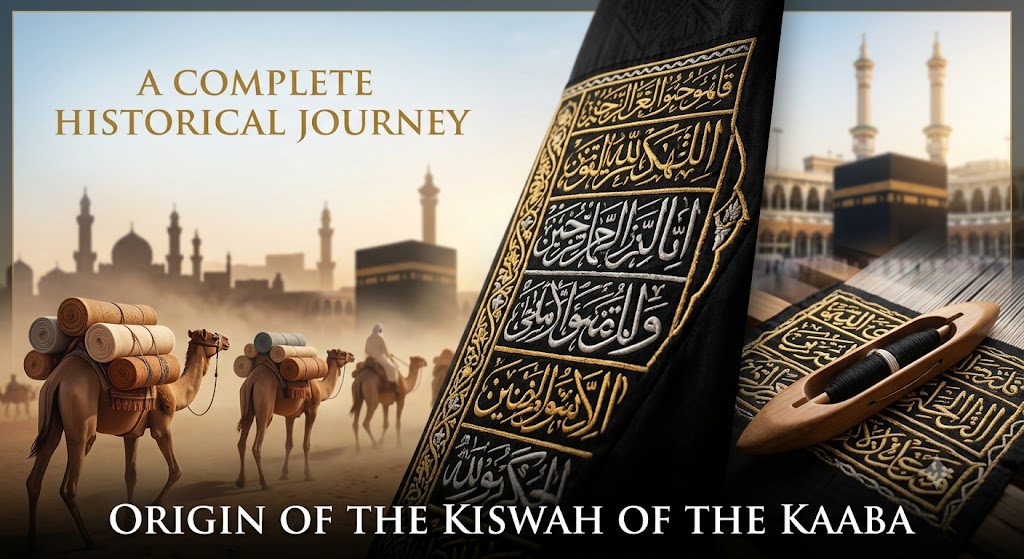
For millions of Muslims across the United Kingdom and around the globe, the sight of the Holy Kaaba in Makkah is the ultimate symbol of spiritual connection and devotion. Standing majestically at the heart of the Masjid al-Haram, the Kaaba is instantly recognisable by its breathtaking, jet-black silk covering adorned with intricate gold calligraphy. This sacred drape is known as the Kiswah.
But have you ever wondered where this beautiful tradition began? The story of the Kiswah is not just one of fabric and thread; it is a profound journey through Islamic history, shifting empires, and unmatched craftsmanship.
In this comprehensive guide, we take a deep dive into the historical origins, evolution, and modern-day production of the Kiswah of the Kaaba.
What is the Kiswah?
The word Kiswah (Arabic: كسوة) translates literally to ‘clothing’, ‘garment’, or ‘drape’. In an Islamic context, it refers specifically to the heavy silk cloth that covers the four sides of the Kaaba. Far from being a mere decoration, covering the Kaaba is an act of deep reverence, respect, and veneration for the House of Allah.
The Pre-Islamic Origins: Who Covered the Kaaba First?
Historical accounts vary regarding who first draped the Kaaba, but Islamic tradition points to a time long before the advent of Islam.
According to several authentic historical texts, the first person to completely cover the Kaaba was Tuba’a al-Himyari, the King of Yemen. Legend dictates that after a dream filled with divine inspiration, the king draped the holy structure with thick Yemeni cloth known as Khasf. Later, he upgraded it to Ma’afir and Mula’at—finer, woven fabrics of high quality.
Following his example, various pre-Islamic Arab tribes took turns providing the covering. During this era, the Kiswah was not exclusively black; it was often made from red, green, or white striped fabrics, depending on the materials available to the prevailing tribe.
The Islamic Era: A Tradition Honoured by the Prophet (PBUH)
When the Prophet Muhammad (PBUH) liberated Makkah, the existing pre-Islamic Kiswah was left intact until it accidentally caught fire after being perfumed by a woman. Following this incident, the Prophet (PBUH) covered the Kaaba with a fine Yemeni white cloth (Al-Ma’afir).
During the reigns of the Rightly Guided Caliphs, the tradition evolved:
- Abu Bakr (RA) and Umar (RA) continued to drape the Kaaba using fine Egyptian linen known as Qabati.
- Uthman (RA) introduced a landmark change by ordering two Kiswahs to be made per year—one made of thick silk for the winter and a lighter Qabati linen drape for the summer.
The Evolution of Colour: Why is the Kiswah Black?
While we are accustomed to seeing the Kaaba in its striking black and gold attire, it went through a spectrum of colours across different dynasties:
- The Umayyads and Abbasids: Initially used green, white, and red coverings.
- The Fatimids: Famously preferred pure white silk.
- The Abbasid Caliph Al-Nasir (1179–1225 CE): First introduced a green silk Kiswah, later changing it to a heavy black silk drape.
The black colour stuck. It proved to be highly durable against the intense desert sun and dust, whilst providing a deeply striking contrast against the glistening white marble of the Haram floor.
The Egyptian Era: The Famed Dar Al-Kiswa
For centuries, the absolute best weavers in the world resided in Egypt. Recognising this, various Muslim rulers commissioned the manufacturing of the Kiswah to Egyptian workshops.
By the early 19th century, a specialized government facility called Dar Al-Kiswa was established in Cairo. Every year, a massive, festive caravan known as the Mahmal would travel across the desert from Cairo to Makkah, carrying the newly crafted Kiswah amidst celebration and prayers. This tradition continued until the early 20th century.
Modern Era: Made with Pride in Makkah
In 1927, King Abdulaziz Al Saud ordered the establishment of a dedicated factory in Makkah to manufacture the Kiswah locally, ensuring that the holy garment would be crafted entirely on blessed soil.
Today, this facility is known as the King Abdulaziz Complex for Holy Kaaba Kiswah. It features state-of-the-art automated weaving machinery alongside traditional hand-embroidery workshops where master craftsmen spend months meticulously sewing Quranic verses using pure silver and gold-plated threads.
Quick Facts About the Modern Kiswah:
- Material: It requires roughly 670–700 kg of pure, raw silk imported from Italy, dyed pitch black.
- Precious Metals: Around 120 kg of gold threads and 100 kg of silver threads are used for the calligraphy.
- The Changing Ceremony: Historically changed during the Hajj pilgrimage on the 9th of Dhul Hijjah, the ceremony was moved in recent years to the 1st of Muharram (the Islamic New Year).
Bring the Spirit of the Haram into Your UK Home
The history of the Kiswah reminds us of the timeless beauty, craftsmanship, and dedication embedded within Islamic art. Its patterns evoke a deep sense of nostalgia and spiritual peace for anyone who has stepped foot in Makkah.
If you are looking to bring that beautiful, sacred aesthetic into your daily life, explore our curated collections at Kiswa Islamic Store. From premium velvet prayer mats inspired by the patterns of the Haram to elegant Islamic home decor, modesty wear, and gifts, we help UK families keep their spiritual connections alive.
