
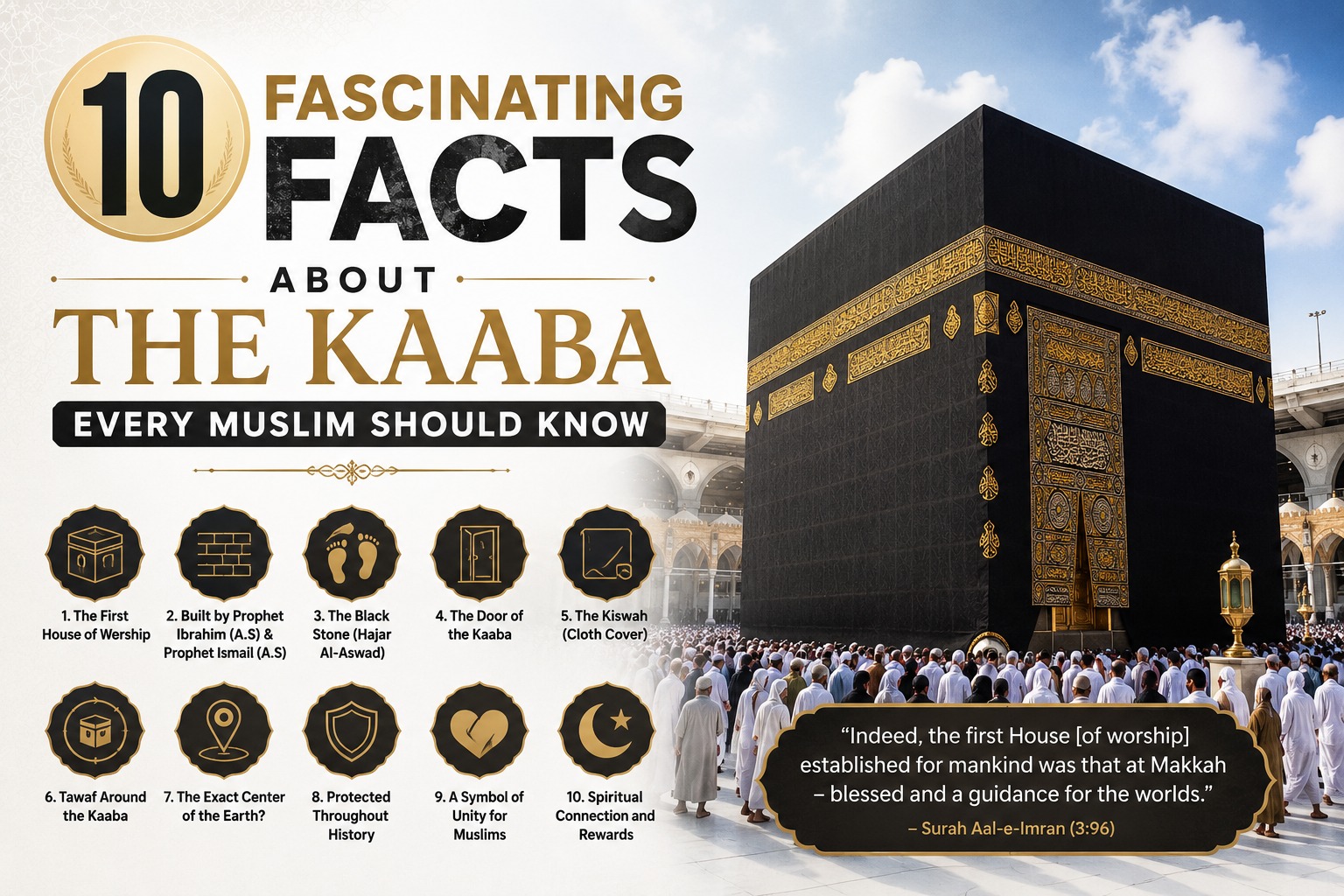
The Holy Kaaba, standing majestically at the heart of Masjid al-Haram in Makkah, is the most sacred site in Islam. As the Qibla—the directional focus for millions of believers during daily prayers—it represents global Muslim unity, spiritual devotion, and thousands of years of prophetic history.
While every Muslim recognizes its distinct cubic shape draped in the majestic black Kiswa, the structure holds deep historical secrets, architectural evolutions, and profound details that are often overlooked. Here are 10 incredible facts about the kaaba every muslim should know that highlight its timeless legacy.

1. It Was Built and Rebuilt Multiple Times in History
The history of the holy kaaba spans several eras, requiring reconstructions across major historical milestones. Islamic tradition holds that the original foundations were laid by the first angels, followed by Prophet Adam (AS). The most famous construction was undertaken by Prophet Ibrahim (Abraham) and his son Prophet Ismail (Ishmael), peace be upon them. Over the centuries, due to natural disasters like flash floods and major conflicts, the Kaaba was rebuilt by the Quraysh (during the youth of Prophet Muhammad ﷺ), by Abdullah ibn al-Zubayr, and later by Hajjaj ibn Yusuf during the Umayyad era.
2. It Originally Had Two Doors and a Window
The contemporary Kaaba features a single, elevated golden door on its northeastern wall. However, during the architectural layout established by Prophet Ibrahim (AS), the structure featured an entry door at ground level on the eastern wall and an exit door on the western side. It also included a window to allow natural light to filter into the interior chamber. The doors were modified into a single, raised entrance during the Quraysh rebuild to restrict access to authorized visitors.
3. The Kaaba Was Originally Multi-Colored
We are accustomed to seeing the Kaaba wrapped elegantly in a deep black silk shroud embroidered with gold-plated calligraphy. However, the tradition of using a solid black cloth was popularized during the Abbasid Caliphate. Before that, the story of the kaaba makkah shows that the structure was adorned with an array of vibrant colors depending on the ruling dynasty. Historical accounts state that the Kaaba was draped in pristine white, brilliant green, and even deep red textiles over various centuries.
4. The Inside of the Kaaba Contains Three Wooden Pillars
Many people wonder about the inside the kaaba secrets and what the interior layout looks like. The inner floor is made of smooth marble, and the walls are clad in protective stone slabs up to the mid-way point. Supporting the heavy ceiling structure are three grand, dark-grained wooden pillars made from premium teak wood, which have stood inside the structure for more than 1,300 years, originally installed by Abdullah ibn al-Zubayr.
5. The Black Stone Is No Longer a Single, Whole Rock
The Hajar al-Aswad (Black Stone), positioned at the eastern corner of the Kaaba, marks the starting and ending point for each round of Tawaf (circumambulation). While it appears to be a large, solid stone framed in a protective pure silver casing, it actually consists of eight small fragments of distinct crystalline rock. The stone was fractured due to historical conflicts and structural damage, most notably during an attack by the Qarmatians in the 10th century.
6. The “Hateem” Area Is Technically Inside the Kaaba
The semi-circular marble wall running adjacent to the northwestern side of the Kaaba is known as the Hateem or Hijr Ismail. When the Quraysh were rebuilding the Kaaba, their tribal leaders pledged to only use purely lawful, halal funds for the construction. Because they ran out of clean wealth before the structure could be completed, they shortened the main cubic frame and left the original foundation space exposed, marking it with this low wall. Praying inside the Hateem grants the same spiritual reward as praying inside the Kaaba itself.
7. It Used to Be Open to Everyone
Up until the relatively recent past, the doors of the Kaaba were regularly opened multiple times a week, allowing ordinary pilgrims and local citizens to casually walk inside to pray. However, as global travel advanced and the number of pilgrims performing Hajj and Umrah swelled into millions annually, the doors had to be secured for crowd management and safety. Today, the interior is opened exclusively twice a year for the ceremonial washing ritual, welcoming royal dignitaries, state officials, and religious scholars.
8. The Keys Are Held by a Single Family Since the Prophet’s Era
Following the conquest of Makkah, the Prophet Muhammad (ﷺ) returned the keys of the Kaaba to Usman ibn Talha of the Bani Shaiba family. The Prophet (ﷺ) declared that the custody of the keys would remain with this specific lineage until the Day of Judgment, and no one could take them away except an oppressor. To this very day, the oldest living member of the Bani Shaiba clan retains possession of the lock’s keys.
9. The Kaaba’s Original Shape Was Not a Perfect Cube
The word Kaaba literally translates to “cube” in Arabic, matching its modern geometric shape. However, because the original construction included the rectangular section now bordered by the Hateem wall, the structure of the holy kaaba built by Prophet Ibrahim (AS) was actually rectangular. It only took on its distinct, symmetrical cubic layout during the shortened reconstruction by the Quraysh.
10. The Fabric Is Manufactured in Its Own Dedicated Complex
The majestic Kiswa is not a standard textile product sourced from standard textile markets. The Saudi government operates the King Abdulaziz Complex for Holy Kaaba Kiswa in Makkah, an entire factory dedicated exclusively to weaving, washing, and hand-embroidering the shroud. A specialized team of over 200 Saudi artisans and calligraphers spend an entire year manufacturing the new fabric, ensuring that every centimeter meets the highest standards of Islamic craftsmanship.
Bringing the Blessings of the Kaaba into Your Home
Reflecting on these profound historical milestones connects us deeper to the roots of our faith. For many collectors and believers, owning an authentic piece of this history is a powerful way to keep that spiritual bond alive. At Kiswah Islamic Store, we help bridge that connection by sourcing certified, framed fragments of the Holy Kiswa, allowing you to display a real piece of the House of Allah in your daily life.
