
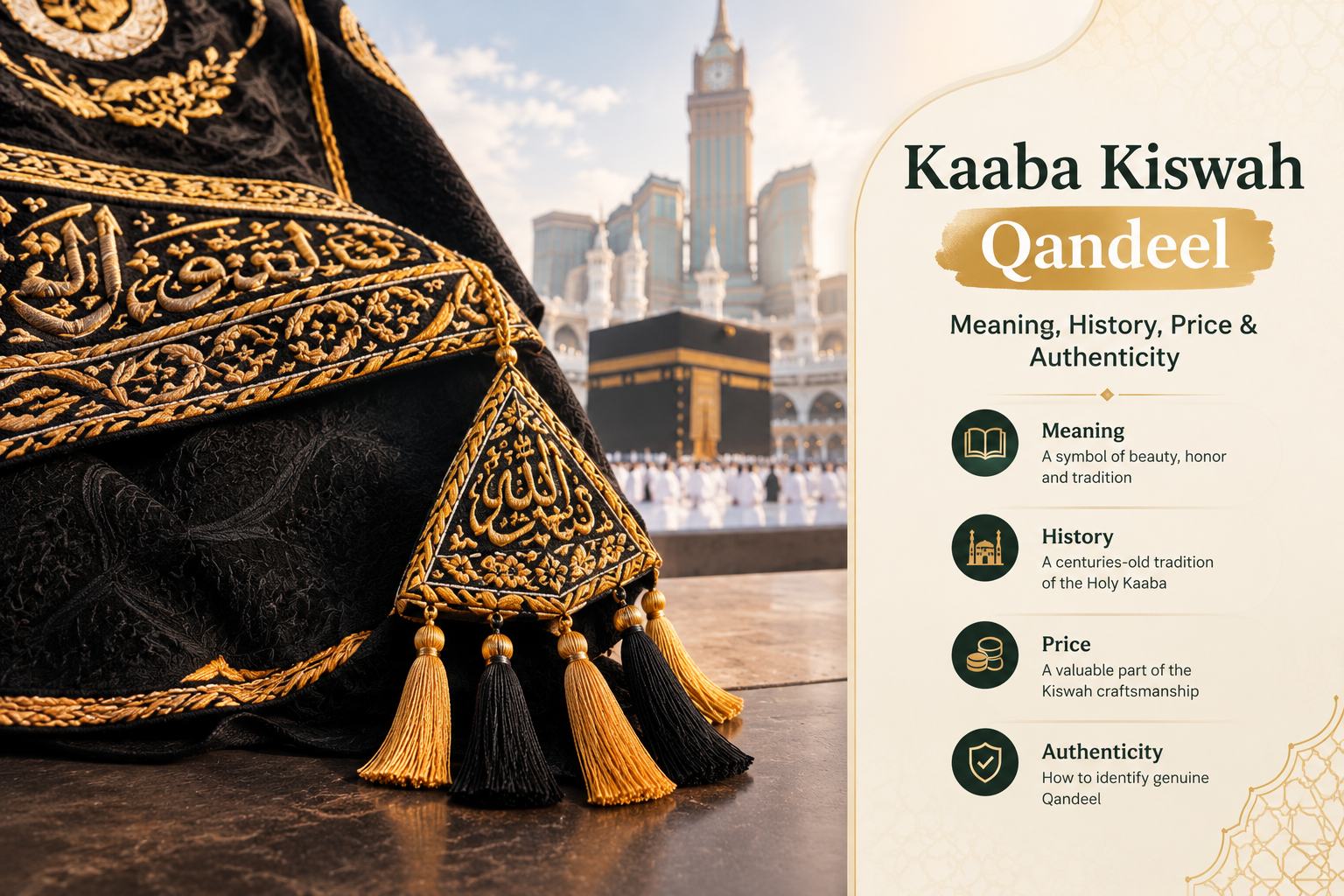
The Kaaba Kiswah Qandeel is one of the distinctive decorative elements associated with the black silk covering of the Holy Kaaba in Makkah. Along with the Hizam, Samadiyat and other embroidered sections, Qandeel motifs contribute to the distinctive visual appearance of the Kiswah. For collectors and people interested in Islamic heritage, a genuine Qandeel can represent a connection with the craftsmanship, calligraphy and history surrounding the Kaaba Kiswah.
The word Qandeel is commonly used for these distinctive decorative sections positioned beneath the main embroidered belt of the Kiswah. Saudi Press Agency describes Qanadeel as one of the defining features of the Kiswah, carrying Quranic verses and Islamic phrases in Arabic calligraphy.
What Is the Kaaba Kiswah?
The Kiswah, also spelled Kiswa, is the covering placed over the Holy Kaaba. The exterior is traditionally made from black silk and decorated with Quranic verses, Islamic phrases and elaborate calligraphy. Gold-plated silver and silver embroidery create the characteristic black-and-gold appearance associated with the Kaaba.
The Kiswah consists of several important sections rather than being one simple piece of cloth. These include the Hizam, decorative elements, Samadiyat and the curtain covering the Kaaba’s door. The Qanadeel are another important decorative component and are positioned beneath the embroidered belt.
Modern Kiswah production takes place at the King Abdulaziz Complex for the Holy Kaaba Kiswah in Makkah. Saudi sources describe a combination of modern technology and specialised hand craftsmanship in its production.
What Is a Qandeel on the Kiswah?
A Kaaba Kiswah Qandeel is a highly decorated calligraphic motif associated with the Kiswah. Rather than being the entire Kaaba covering, it is a distinct embroidered element incorporated into the larger decorative design.
The Qanadeel appear beneath the Hizam and contain Quranic verses and Islamic phrases rendered in Arabic calligraphy. Their carefully arranged shapes make them visually prominent against the black silk background. Saudi Press Agency specifically identifies Qanadeel as distinctive visual markers for worshippers performing Tawaf.
One documented example is the “Ya Hayyu Ya Qayyum” Qandeel. A Saudi heritage collection records a Qandeel example measuring 90 × 90 cm and notes that four such Qandeel pieces exist on the Kiswah.
This makes Kaaba Kiswah Qandeel particularly interesting for collectors because the design is not simply decorative artwork created independently of the Kiswah; it reflects an established component of the Kaaba’s piece decoration.
What Does “Ya Hayyu Ya Qayyum” Mean?
One well-known Kaaba Kiswah Qandeel carries the phrase “Ya Hayyu Ya Qayyum.” These words refer to Allah as the Ever-Living and the Sustainer. The phrase is connected with Quranic wording and is also widely used in Islamic supplication.
The calligraphy gives the Qandeel both visual and religious significance. However, the value of a genuine Kaaba Kiswah Qandeel should be understood through its connection with the Kaaba, its craftsmanship, historical context and provenance rather than treating the fabric itself as an object of worship.
History of the Kaaba Kiswah
The tradition of covering the Kaaba is very old and extends back to the period before Islam. Historical accounts mention different people and communities associated with covering the Kaaba at different times. The design, colour and materials of the covering also changed throughout history.
During later Islamic periods, the Kiswah developed into an increasingly elaborate fabric incorporating calligraphy and decorative work. Egypt became an important centre for Kiswah production for a significant period.
In the Saudi era, production gradually became established in Makkah. Saudi historical sources record that King Abdulaziz ordered the establishment of a dedicated workshop for producing the Kiswah in Makkah in 1346 AH/1927. Modern production subsequently developed into the King Abdulaziz Complex for the Holy Kaaba Kiswah.
Therefore, today’s Qandeel is part of a much longer tradition of traditional craftsmanship surrounding the covering of the Kaaba.
How Qandeel Fits Into the Kiswah Design
The Kiswah is designed as a complete visual composition. The Hizam forms the major embroidered belt around the upper section, while the Kaaba Kiswah Qanadeel are positioned beneath it. Samadiyat are also prominent decorative elements, particularly at the corners, and incorporate passages from Surah Al-Ikhlas.
The Qandeel therefore should not be confused with the Hizam. The Hizam is the broad belt that extends around the Kaaba, while Qandeel refers to individual decorative sections within the larger composition.
The craftsmanship involves several stages, including design, printing, weaving and embroidery. Gold and silver threads are incorporated into the fabric to produce the detailed calligraphy and ornamentation.
What Verses and Phrases Are Found on the Kiswah?
The Kiswah contains Quranic verses and Islamic phrases written in Arabic calligraphy. The current design uses Thuluth Jali Murakkab calligraphy, a style suited to the complex compositions required for the Kiswah.
Different sections contain different inscriptions. The Hizam carries Quranic passages, while Qanadeel beneath the belt contain Quranic verses and phrases. Samadiyat incorporates passages from Surah Al-Ikhlas.
Examples of Quranic material associated with Kiswah inscriptions include passages from Surah Al-Baqarah, Surah Al-Fath, Surah Al-Ikhlas and Surah An-Nur. The exact arrangement and design can vary according to the Kiswah design and production period.
This distinction is important when discussing a particular Qandeel. A buyer should not assume that every Kaaba Kiswah Qandeel contains exactly the same inscription. The specific phrase or verse should be checked against the individual piece and its documentation.
Materials and Craftsmanship
The exterior Kiswah is made using specially prepared silk and decorated with elaborate embroidery. Official Saudi information from 2026 describes the use of natural silk, cotton lining, pure silver and gold-plated silver in the production process.
The embroidery combines precision machinery with skilled manual work. The calligraphy must be accurately transferred and embroidered so that the letters maintain their proportions and visual structure.
A Kaaba Kiswah Qandeel therefore represents only one part of a much larger manufacturing process. Its appearance depends on the quality of the silk, embroidery, calligraphic design and finishing.
Spiritual and Historical Significance of Qandeel
The significance of a Qandeel comes from its association with the Kiswah and the Holy Kaaba. Muslims face the Kaaba during daily prayers and visit it during Hajj and Umrah, making the Kiswah closely connected with Islamic worship and the history of Makkah.
For collectors, an authentic Kaaba Kiswah Qandeel can also have historical and emotional value because it represents a component of the covering traditionally placed on the Kaaba.
At the same time, the fabric itself is not an object of worship. Islamic worship is directed to Allah alone. A genuine Kiswah Qandeel can be respected as a historical and religiously significant artefact without attributing independent supernatural powers to the material.
How Kiswah and Qandeel Are Distributed
When an old Kiswah is replaced, the previous covering is carefully removed as part of the official replacement process. Saudi authorities have documented the removal of decorative elements and the old covering during the annual replacement operation.
Pieces of previous Kiswah may subsequently be preserved, transferred or presented through authorised channels to institutions, museums, organisations, dignitaries and other recipients, depending on the applicable arrangements.
This history is important when evaluating a Kaaba Kiswah Qandeel offered for sale. A seller should be able to explain the origin of the particular piece and provide documentation where available. A photograph that merely resembles a Kaaba Kiswah Qandeel is not, by itself, proof of authenticity.
Where to Buy a Kaaba Kiswah Qandeel
Collectors looking for Kiswah-related products can explore specialist online stores. The Kiswah Islamic Store collection is available through its official shop:
Another online source is:
Kiswah-related products are also available through the Islamic Kiswah Store on Etsy, which can be explored here:
Availability, design, size and pricing can differ between sellers. For a Qandeel or other valuable Kiswah piece, buyers should carefully read the product description and ask about its dimensions, material, provenance, certificate and shipping arrangements before purchasing.
How to Verify Qandeel Authenticity
Authenticity is one of the most important considerations when purchasing a Kaaba Kiswah Qandeel. Buyers should look beyond the appearance of the embroidery and examine the documentation associated with the piece.
A useful authenticity review can include:
- Certificate or documentation supplied with the piece
- Clear information about provenance
- Material and embroidery details
- Exact dimensions
- Photographs of the front and back
- Seller information and purchase invoice
- Any available history connecting the piece with a recognised source
Before purchasing an original Kiswah piece or Qandeel, buyers can also use the Kiswah Verification to check the available verification information for a Kiswah piece. This provides an additional step for buyers who want to research authenticity before completing a purchase.
Buyers can also explore the information provided by Kaaba Kiswa to learn more about Kiswah pieces and authenticity.
For expensive pieces, it is sensible to request documentation before completing payment. The certificate should be examined carefully rather than accepted simply because the word “original” appears in a product description.
Using more than one authenticity check can help buyers make a better-informed decision, particularly when purchasing a valuable Kaaba Kiswah Qandeel from an online seller or secondary market.
Qandeel Size and Price
There is no single universal price for every Qandeel. The value can depend on its size, embroidery, design, condition, provenance, documentation, framing and seller.
For example, a documented “Ya Hayyu Ya Qayyum” Qandeel in a Saudi heritage collection is recorded at 90 × 90 cm. Other Qandeel-related pieces can differ in dimensions and design.
Small Kiswah fragments may be available at comparatively lower prices, while larger calligraphic pieces and documented collectible sections can command significantly higher prices. Buyers should therefore compare the exact product specifications rather than assuming that all Kiswah or Qandeel pieces have the same market value.
How to Pay and Receive a Qandeel
Payment methods depend on the seller and location. Online stores may provide options such as PayPal, credit cards, debit cards or online banking, subject to the payment methods currently offered by the seller.
International delivery also depends on the seller, shipping provider, destination and customs process. Buyers should check the estimated delivery period before placing an order and ask whether tracking and protective packaging are provided.
A framed Qandeel requires particularly careful packaging because the fabric, frame and glazing can be vulnerable during international transportation.
Why Collect a Kaaba Kiswah Qandeel?
A Qandeel offers a different way to appreciate the artistry of the Kiswah. Instead of viewing the entire covering only as a large decorative element, a collector can focus on an individual calligraphic component and examine its embroidery, wording, geometry and craftsmanship.
For people interested in Islamic art, Arabic calligraphy, Makkah heritage or Kaaba-related artefacts, a documented Kaaba Kiswah Qandeel can become an important part of a personal collection.
Final Thoughts
The Kaaba Kiswah Qandeel is an important decorative component of the Kiswah, combining Arabic calligraphy, traditional embroidery and the heritage associated with the Holy Kaaba. Its position beneath the Hizam and its Quranic or Islamic inscriptions make it one of the visually distinctive elements of the covering.
Anyone considering a purchase should look carefully at authenticity, provenance, dimensions, materials, documentation, price and delivery arrangements. Specialist collections such as Kiswah Islamic Store, Kiswah Al Kabah and Etsy can be explored for available products.
For additional information about Kiswah history, craftsmanship and authenticity, readers can visit Kaaba Kiswa. Understanding the story behind the Kiswah and Qandeel allows buyers to appreciate not only their appearance, but also the calligraphic, historical and cultural heritage they represent.
