
The Hajar Aswad, commonly known as the Black Stone, is one of the most recognized features of the Holy Kaaba in Makkah. Every year, millions of Muslims performing Hajj and Umrah begin their Tawaf from the corner where the stone is placed. Although it is deeply respected, the Hajar Aswad is not worshipped. Instead, it is honored because of its connection to the Prophet Ibrahim (AS), Prophet Ismail (AS), and the Sunnah of Prophet Muhammad ﷺ.
For Muslims, the Black Stone serves as a reminder of faith, obedience, and the rich history of Islam.
Where Is the Hajar Aswad Located?
The Hajar Aswad is fixed into the eastern corner of the Holy Kaaba inside Masjid al-Haram. It marks the point where pilgrims begin and complete each of the seven circuits of Tawaf.
When the area is crowded, pilgrims simply point toward the Black Stone instead of trying to reach it. This practice follows the Sunnah while ensuring the safety and comfort of others.
The Origin of the Black Stone
Islamic traditions explain that the Hajar Aswad has been associated with the Kaaba since the time of Prophet Ibrahim (AS) and Prophet Ismail (AS), who rebuilt the Sacred House by Allah’s command.
As the Kaaba was completed, the Black Stone was placed in its designated position, becoming an important landmark for future generations of believers. Throughout history, it has remained closely connected with Islamic worship and pilgrimage.
A Lesson in Wisdom from Prophet Muhammad ﷺ
One of the most famous events involving the Hajar Aswad occurred before Prophet Muhammad ﷺ received revelation.
When the Kaaba was rebuilt, the leaders of Makkah disagreed over which tribe should have the honor of placing the Black Stone back into the wall. The dispute was peacefully resolved by Muhammad ﷺ, who spread a cloth on the ground, placed the stone in the center, and asked representatives from each tribe to lift it together. He then positioned the stone himself.
This event demonstrated fairness, wisdom, and leadership long before his prophethood.
Why Do Pilgrims Respect the Hajar Aswad?
The importance of the Black Stone comes from its connection with Islamic history and the Sunnah.
Pilgrims respect the Hajar Aswad because:
- It is part of the Holy Kaaba.
- Prophet Muhammad ﷺ kissed and touched it during Tawaf.
- It marks the starting point of every Tawaf.
- It reminds Muslims of the legacy of Prophet Ibrahim (AS).
Respect for the stone should never be confused with worship. Muslims worship only Allah.
The Sunnah During Tawaf
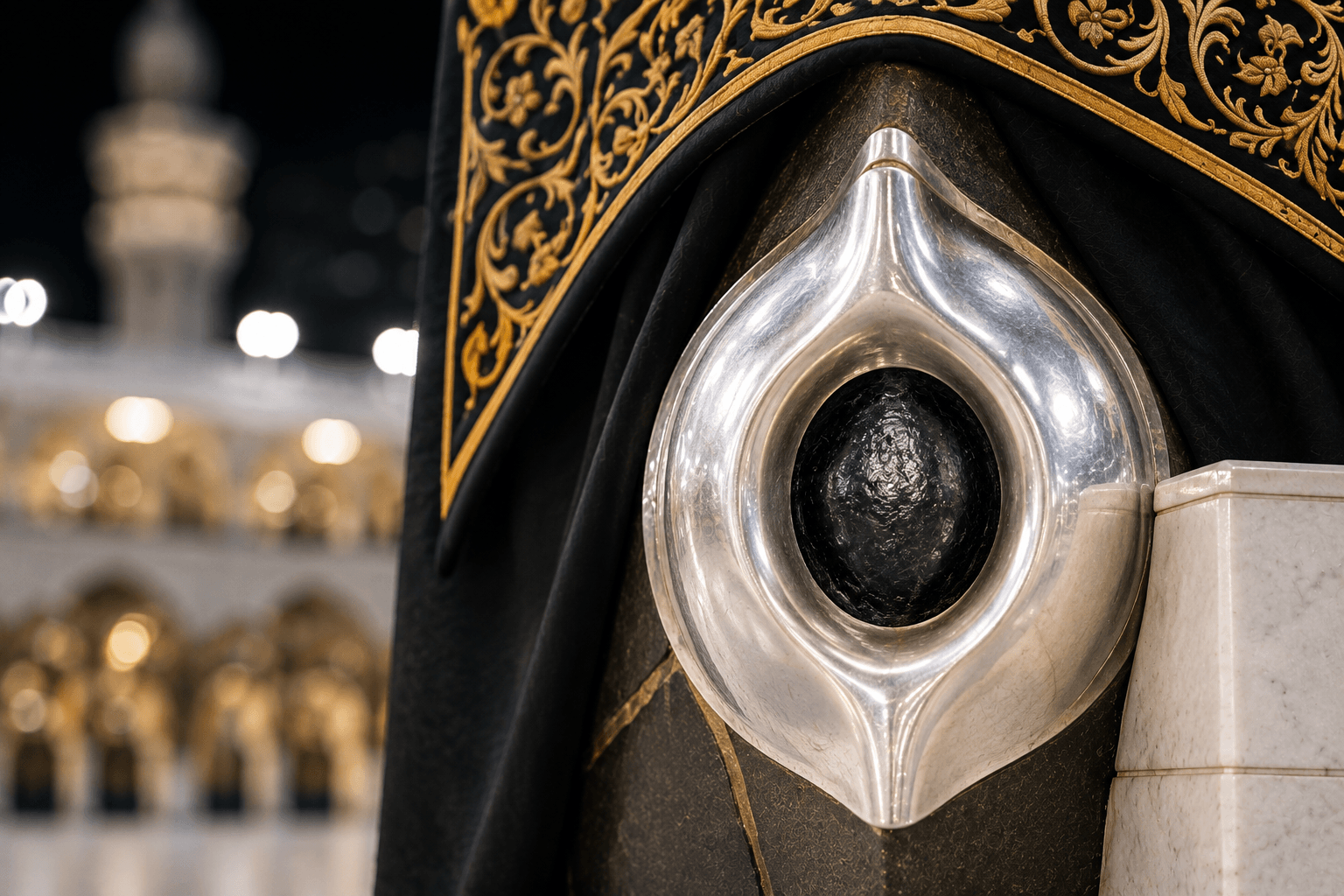
During Tawaf, pilgrims begin each circuit from the corner containing the Hajar Aswad.
If possible, they may kiss or gently touch the stone. However, when crowds make this difficult, pilgrims simply face the stone, raise their right hand toward it, and continue walking without causing inconvenience to others.
Islam emphasizes patience, humility, and respect for fellow worshippers during pilgrimage.
Preserving the Black Stone
The Hajar Aswad has experienced centuries of history and has been carefully preserved over time. Today, its visible fragments are secured within a silver frame attached to the Holy Kaaba.
This protective frame helps maintain the stone while allowing pilgrims to recognize its location during Tawaf.
Common Questions About the Hajar Aswad
Is touching the Black Stone compulsory?
No. Touching or kissing the Hajar Aswad is Sunnah, not an obligation. If reaching it is difficult, pointing toward it is sufficient.
Does the Black Stone have supernatural powers?
In Islam, Muslims do not believe that the Hajar Aswad has independent power to benefit or harm anyone. It is respected because of its connection to the Holy Kaaba and the practice of Prophet Muhammad ﷺ.
Can every pilgrim reach the Black Stone?
Due to the large number of visitors in Masjid al-Haram, many pilgrims cannot reach the stone directly. Islamic teachings encourage people not to push or harm others simply to touch it.
Conclusion
The Hajar Aswad remains one of the most significant historical features of the Holy Kaaba. Its association with Prophet Ibrahim (AS), Prophet Ismail (AS), and Prophet Muhammad ﷺ makes it an important part of Islamic tradition and pilgrimage.
For Muslims, the Black Stone is a symbol of continuity, faith, and obedience to Allah. Whether a pilgrim is able to touch it or simply point toward it during Tawaf, the spiritual reward comes from sincere worship, humility, and following the teachings of Islam.
