
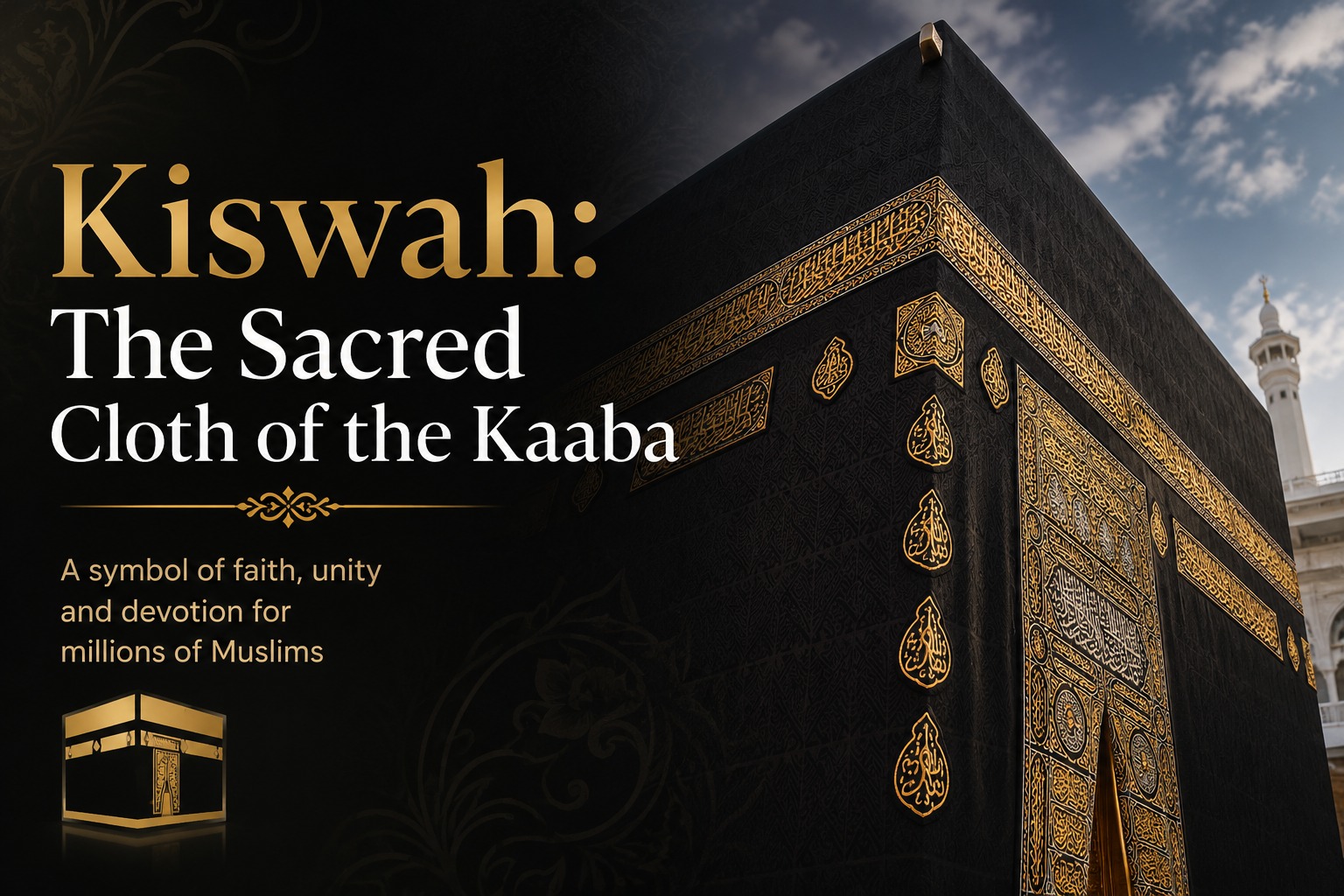
Every year, millions of Muslims around the world turn their gaze toward Mecca, home to the Kaaba — the most sacred structure in Islam. Draped over this cube-shaped building is a magnificent black cloth known as the Kiswah. Far more than a simple covering, the Kiswah is a masterpiece of textile art, a symbol of devotion, and a tradition that has been carried forward for centuries. This article explores what the Kiswah is, its history, how it is made, and why it holds such deep significance for Muslims worldwide.
What Is the Kiswah?
The word “Kiswah” comes from Arabic and simply means “garment” or “covering.” It refers to the enormous black silk cloth that envelops the Kaaba on all four sides, giving the structure its distinctive, solemn appearance. The cloth is not plain — its upper section features intricate embroidery in gold and silver thread, showcasing verses from the Quran, the names of Allah, and phrases central to Islamic belief.
This embroidered section, positioned near the top of the cloth, is known as the “Hizam” or belt. It wraps around the Kaaba like a golden ribbon, standing out vividly against the deep black silk beneath it. The combination of the somber black fabric and the shimmering gold calligraphy creates a striking visual that has come to symbolize the sanctity of the Kaaba itself.
A Tradition Older Than Islam
Interestingly, the practice of covering the Kaaba did not begin with Islam. Historical accounts suggest that even in pre-Islamic Arabia, the Kaaba was draped in cloth as a mark of reverence, though the materials and designs varied considerably over time. Some early coverings were made of leather, while others used different colored fabrics brought by various tribal leaders and rulers.
After the advent of Islam, the tradition continued and evolved. Various Islamic dynasties and caliphates — including the Abbasids, Fatimids, and Ottomans — took turns providing the Kiswah, often as a mark of political and religious prestige. Different empires used different colors and styles at various points in history, including white, green, and red fabrics, before black became the standard color used today.
In the modern era, the responsibility of producing and providing the Kiswah has been assumed by the government of Saudi Arabia, which oversees its production through a dedicated state-run facility.
How the Kiswah Is Made
Today, the Kiswah is manufactured at a purpose-built facility in Mecca called the King Abdul Aziz Complex for the Kiswa of the Holy Kaaba. This facility employs a combination of traditional craftsmanship and modern technology to produce a covering of extraordinary scale and detail.
The production process involves several remarkable elements:
- Fabric: The Kiswah is made from approximately 670 kilograms of pure silk, which is dyed a deep, uniform black.
- Embroidery Threads: Around 120 kilograms of gold and silver thread are used to embroider the Quranic verses and calligraphy that decorate the Hizam band.
- Dimensions: The finished cloth stands roughly 14 meters in height and is divided into large panels that are sewn together to fully wrap around the Kaaba’s four sides.
- Workforce: Hundreds of skilled artisans, calligraphers, and embroiderers work alongside computerized machinery to ensure precision in every stitch, particularly for the delicate calligraphic sections that cannot be rushed or mass-produced without losing their artistic integrity.
The entire process, from dyeing the silk to completing the embroidery, can take many months and reflects a blend of centuries-old craftsmanship with contemporary manufacturing techniques.
The Ceremony of Changing the Kiswah
One of the most moving aspects of this tradition is the annual replacement of the Kiswah. Each year, during the Hajj pilgrimage, specifically on the 9th of Dhul Hijjah — known as the Day of Arafah — the old Kiswah is carefully removed and replaced with a newly prepared one. This event is timed to coincide with one of the most significant days of the Islamic calendar, when millions of pilgrims are gathered in the vicinity of Mecca.
The changing ceremony is conducted with great care and solemnity by designated officials and religious authorities. Once removed, the old Kiswah is not discarded. Instead, it is cut into smaller pieces and distributed as gifts to Islamic organizations, heads of state, museums, and other dignitaries around the world. These fragments are treasured as precious relics, often displayed in museums or private collections as reminders of this sacred tradition.
Why the Kiswah Matters
For Muslims, the Kiswah represents far more than decorative fabric. It embodies the unity of the global Muslim community, the reverence held for the Kaaba as the spiritual center of Islam, and the enduring connection between faith and artistic expression. The painstaking effort invested in its creation each year — from the selection of raw silk to the final stitch of gold thread — reflects the depth of devotion that surrounds this sacred structure.
The Kiswah also serves as a visual anchor for the millions of pilgrims who perform Hajj and Umrah each year. As they circle the Kaaba during the ritual of Tawaf, the sight of the black cloth adorned with golden calligraphy becomes an unforgettable and deeply spiritual image, one that stays with them long after their pilgrimage ends.
Conclusion
The Kiswah is a remarkable fusion of history, faith, and craftsmanship. From its pre-Islamic origins to its modern production using both traditional skill and advanced technology, this sacred covering continues to hold profound meaning for Muslims across the globe. More than just a cloth draped over a building, the Kiswah stands as a living testament to centuries of devotion, artistry, and the enduring spiritual significance of the Kaaba in the heart of Islam.
